News
27.10.2026MICS in the Central Region: children, local authorities and the civil sector together on priorities for improving the position of children
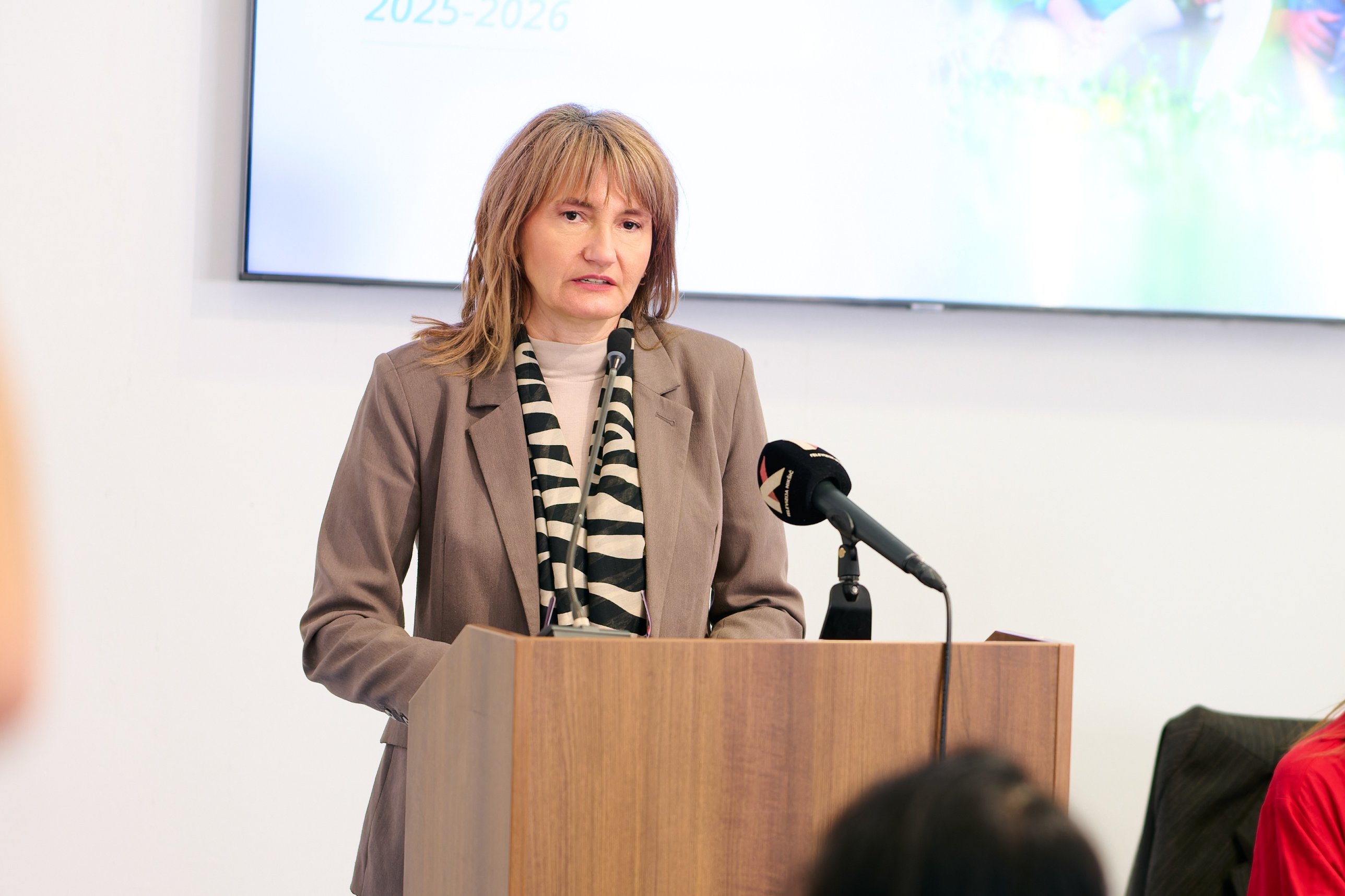
The Statistical Office of Montenegro (MONSTAT) and UNICEF Montenegro, with the support of the Municipality of Nikšić, held a regional workshop on 26 October 2026. At the workshop, the results of the Multiple Indicator Cluster Survey (MICS) 2025–2026 for the Central Region were presented.
The workshop was held in the Tehnopolis hall. It brought together representatives of municipalities in the Central Region, institutions, civil society organisations and Roma organisations, as well as Roma mediators. Children also took part and, with the support of the Child Rights Centre, shared their views and proposals on what needs to change in their communities.
The workshop continues the presentation of the MICS findings, which were published on 21 September in Podgorica. The aim is for the internationally comparable data to reach local communities. The data should help identify the needs of children and families, target resources better, and support policy planning and monitoring at local and national level.
“Behind every number there is someone’s daily life, which no table can fully tell. That is why it is important that we see the survey results not as statistics, but as an opportunity to recognise people’s needs, especially the needs of those whose voices are least often heard. As a local government, we cannot solve every problem, but we can be more careful about what we recognise as a problem, whose voice we hear and whom we include in decision-making. It is important that behind statistical data we recognise real people, their needs and the challenges they face every day. In the end, what matters is not how much data we have collected, but whether, thanks to what we have learned, someone’s life will become at least a little easier,” said Maja Todorović, MSc, Secretary of the Secretariat for Social Welfare of the Municipality of Nikšić.
“The value of these data lies not only in statistical reporting. They should be the basis for evidence-based policies and programmes, better planning and allocation of resources, and monitoring of progress. That is why MICS should not end with the publication of a report. Its real value begins when we use the data. That is exactly why we are in Nikšić today,” said Branka Raičević, Assistant Director of the Statistical Office of Montenegro.
“Although more children in the Central Region attend preschool education today than in 2018, data from Roma settlements show that this progress is not equal for all children. At the same time, violent discipline of children living in the central part of Montenegro has become more widespread, both in the general population and in Roma settlements. MICS clearly shows that additional investment is needed in more accessible preschool education for Roma children and in programmes that give parents practical support in non-violent parenting. UNICEF is already supporting the development of such programmes, and the aim is for them to become part of the regular services available to children and families in all local communities,” said Senad Begić, Acting Deputy Representative of UNICEF Montenegro.
The results for the Central Region were presented by Jovana Živković of the Statistical Office of Montenegro and by Nela Krnić and Serdjan Baftijari of UNICEF Montenegro. The data show that in some areas the Central Region is making progress and is ahead of the national average. They also point to challenges in protecting children from violence and in other areas of their development.
Early childhood education programmes are attended by 73.4% of children aged 36–59 months in the Central Region, compared with 59.6% in 2018. At the national level, this percentage rose from 52.8% to 63.0%. The share of children one year younger than the official primary school entry age who take part in organised learning increased in the Central Region from 71.1% to 88.7%, and at the national level from 67.0% to 79.0%.
The share of newborns put to the breast within the first hour after birth in the Central Region increased from 19.9% to 40.7%, close to the current national average of 41.3%. In the Central Region, 90.5% of households have internet access at home, compared with 71.4% in 2018. The current national figure is 91.0%.
The data also point to areas that require particular attention. In the Central Region, 71.9% of children aged 1–14 years experienced psychological aggression and/or physical punishment by adult household members in the month preceding the survey, compared with 66.8% in 2018. At the national level, this percentage increased from 65.8% to 69.0%.
Some children under five were left alone or in the care of a child under ten for more than one hour, at least once during the week preceding the survey. Their share increased in the Central Region from 5.2% to 10.5%, and at the national level from 4.6% to 12.1%. The share of overweight children under five in the Central Region rose from 3.8% to 9.0%, while a smaller change was recorded at the national level, from 7.3% to 7.8%.
Some women aged 15–49 years believe that a husband is justified in hitting his wife for at least one reason. Their share decreased in the Central Region from 6.7% to 3.0%, and at the national level from 6.1% to 3.8%. In the Central Region, 84.6% of women aged 15–49 years feel safe walking alone in their neighbourhood after dark, compared with 81.2% in 2018. The current national figure is 89.1%. Basic drinking water services are used by 99.8% of the population of the Central Region.
In Roma settlements in the Central Region, the share of children one year younger than the official primary school entry age who take part in organised learning decreased from 40.8% to 16.8%. Across all Roma settlements in Montenegro, it decreased from 36.4% to 16.2%. At the same time, the share of first-grade pupils from Roma settlements in the Central Region who attended preschool the previous year fell from 53.7% to 22.4%.
Progress was recorded in secondary education. Today, 15.4% of children of secondary school age from Roma settlements in the Central Region attend secondary school or higher, compared with 7.2% in 2018. Across all Roma settlements in Montenegro, this percentage rose from 7.1% to 16.7%.
The share of women aged 20–24 years from Roma settlements in the Central Region who were first married or in union before the age of 18 decreased from 62.9% to 31.0%. Across all Roma settlements in Montenegro, it decreased from 60.0% to 33.5%. Despite the decline, almost one third of young women in this group in the Central Region were married or in union before reaching adulthood.
In Roma settlements in the Central Region, 87.1% of children aged 1–14 years experienced violent disciplinary methods, compared with 65.4% in 2018. The current figure for all Roma settlements in Montenegro is 86.0%. Discrimination or harassment on at least one ground in the previous 12 months was reported by 17.0% of women aged 15–49 years from Roma settlements in the Central Region. The figure was 8.4% in 2018, and it is currently 26.1% across all Roma settlements in Montenegro.
The second part of the workshop was dedicated to a dialogue between children, local authorities, institutions and civil society organisations on the implementation of the Convention on the Rights of the Child. The consultations addressed the most urgent problems facing children in the Central Region, in the areas of education, health and health care, protection from violence, and social protection.
MICS is an internationally comparable household survey developed by UNICEF. It has been conducted in Montenegro since 2006. The survey whose findings were published in 2026 is the sixth in Montenegro and part of the seventh global round (MICS7). It was carried out on a sample of 6,720 households from the general population and 1,189 households in Roma settlements. The survey was conducted by the Statistical Office of Montenegro, with technical support from UNICEF Montenegro and financial support from UNICEF and the Government of Montenegro.
The full report and MICS data are available on the website of the Statistical Office of Montenegro: https://www.monstat.org/eng/page.php?id=1562&pageid=16


